Here's a youtube video of a performance in the old synagogue in Boskovice from this summer's Boskovice Festival -- a jazz version of Lecha Dodi prayer, composed by Peter Gyori (also on guitar) and sung by Lenka Lichtenberg.
Showing posts with label Czech Republic. Show all posts
Showing posts with label Czech Republic. Show all posts
Saturday, April 30, 2011

Monday, April 18, 2011
Czech Republic -- Singer records Yiddish CD in synagogues

Inside the synagogue in Mikulov, now a museum, Photo (c) Ruth Ellen Gruber
by Ruth Ellen Gruber
The Czech-born Canadian singer Lenka Lichtenberg is recording Yiddish and Jewish liturgical songs for a new CD in several former synagogues scattered around the Czech Republic -- in Prague, Plzen, Radnice, Liberec, Turnov, Boskovice, Mikulov, Polna, Hartmanice. Some of these synagogues are used now as museums.
Lichtenberg told the Czech news agency CTK that she envisaged the CD as a "certain homage to synagogues, their atmosphere and the local Jewish communities that do not exist any longer".
She said it crossed her mind to record Jewish liturgic songs in synagogues in the country last year when she had a concert in the synagogues in Liberec, north Bohemia, and in Plzen, west Bohemia. Each of the 14 songs will be recorded in a different synagogue as every synagogue has specific acoustics and every venue will fill the song with a different content and spirit, Lichtenberg said. Apart from traditional liturgic songs, the CD will offer two songs that she has written and four by modern authors from Toronto. Lichtenberg has also recorded one song, a prayer for the dead, in a hidden synagogue in Terezin, north Bohemia, where an internment camp for European Jews was set up during WWII. Her mother was interned there, she recalled. The CD will include a booklet with photographs of the synagogues and information about the local Jewish communities. It should also be sold in the synagogues where it was recorded.Read full CTK story here
Tuesday, March 29, 2011
Romania/CZ -- Czech 9 Gates Festival in Bucharest
By Ruth Ellen Gruber
This year, the annual (and of late traveling) 9 Gates Festival of Czech Jewish Culture is being hosted in Bucharest, Romania.
The schedule includes:
For a full schedule click HERE
This year, the annual (and of late traveling) 9 Gates Festival of Czech Jewish Culture is being hosted in Bucharest, Romania.
The schedule includes:
EXHIBITIONS
Neighbors who Disappeared
The project Neighbors Who Disappeared provides young people (12-21 years old) with an opportunity to search for neighbors who "disappeared" from their neighborhood - particularly during the Second World War. Students and children in the same schools children go to today, and what were the reasons for their sudden departure.
Tribute to the Child Holocaust Victims
The second stage of the project called A Tribute to the Child Holocaust Victims addresses again young people aged 12-21 and proposes tht they work independently on the stories of people who lived with their neighbours in a harmony until WWII and who were then mostly marked, restricte, persecuted, and finally liquidated. This projct’s topic, however is in the first place the life of the children and youngsters in the same community where children-participants live today.
FILM
Short Long Journey, Czech Republic, 2009, 82 min.
Director: Martin Hanzlicek
Producers: Fedor Gal, Jarmila Polakova
„About people, not only about Jews, about the evil in us, not only about the holocaust, about the present not only about the past“
In April 1945 Vojtech Gal was murdered on the way from Sachsenhausen to Schwerin. In April 2008 his son walked the same route in an attempt to find his father’s grave and leave a testimony. He was accompanied by friends, film makers and fellow pilgrims. They did not understand everything they came across. They could not comprehend some of the people with whom they talked. But it never occurred to them even for a moment that they were travelling without aim and meaning. They give harsh personal witness of their journey, anticipating neither agreement nor tolerance.
Diamonds of the Night, Cehoslovacia, 1964, 64 min.
Director: Jan Nemec
Screenplay: Arnost Lustig
Diamonds of the Night is set in Czechoslovakia during World War II. Two Jewish youths escape from a concentration camp-bound train. Captured by local peasants on a charge of stealing bread, the boys are sentenced to a firing squad. The men prepare to execute the boys, but simply laugh as they walk away instead of executing them. The ending is ambiguous: The men either actually spared the boys, or they could be walking into the afterlife.
MUSIC
Concert Naches
The Klezmer band NACHES interprets the traditional and the not so traditional folk music of the East European Jews. The band has taken part of many important Klezmer festivals, for example Klez- Fest in the UK.
For a full schedule click HERE
Friday, February 25, 2011
Jewish Culture/Music/Etc Festivals 2010

Posters for last year's Quarter6Quarter7 Hanukkah festival in Budapest. Photo (c) Ruth Ellen Gruber

A number of Jewish culture festivals of all sorts take place around Europe in the spring and summer (and beyond). Some are dedicated just to music. Some to film. Others are much broader. As far as I know, there is no central web site where you can find information on all of them. I will begin to post information here on dates and venues. I ask my readers to please send me information to include!
The culture festivals and other smaller events make good destinations around which to center a trip. Some, like the annual Festival of Jewish Culture in Krakow, are huge events lasting a week or more, which draw thousands of people and offer scores or sometimes hundreds of performances, lectures, concerts, exhibits and the like. Other festivals are much less ambitious. Some are primarily workshops but also feature concerts. Many of the same artists perform at more than one festival.
The list will be growing and growing -- and again, I ask my readers to please send me information and links to upcoming events. Thanks!
ALL OVER EUROPE -- 11th annual European Day of Jewish Culture. The first Sunday in September -- Sept. 5. Events take place in nearly 30 countries. The theme this year is Art and Judaism.
AUSTRIA
April 22-27 -- Vienna -- Stay Jewish! (Film Festival)
October 14-November 14 -- Vienna -- Yiddish Culture Autumn (web site under construction)
November 6 - 21 -- Vienna -- KlezMORE festival (this year's program is not up yet)
CROATIA
Aug. 23-31 -- Opatija -- Bejahad 2010
CZECH REPUBLIC
July 8-11 -- Boskovice -- Boskovice Festival. Mainly jazz, but also an emphasis on Jewish culture, given the importance of the well-preserved former Jewish quarter, cemetery and Jewish museum in the restored synagogue.
July 29-31 -- Trebic -- Seventh edition of the Trebic Jewish Culture Festival, held in the Czech Republic's most extensive preserved former Jewish quarter
FRANCE
April 9 - July 18 -- Paris -- Radical Jewish Culture exhibit (and concerts), Jewish Museum
June 13-28 -- Paris -- 6th Festival of Jewish Cultures
July 5-9 -- Paris -- Klezmer Paris festival Lots of workshops from an all-star international team of musicians and teachers.
GERMANY
March 5-14 -- Fürth -- Fürth International Klezmer Festival (12th edition)
July 3-August 2 -- Weimar -- Yiddish Summer Weimar
October 17-31 -- Dresden -- The 14th Yiddish Weeks Dresden
November 20-30 -- Munich -- The 24th Jewish Culture Days, Munich (devoted this year to Jewish Berlin)
HUNGARY
April 2-4 -- Budapest -- Mini-Israeli-Film-Festival, Kino cinema club
August 5-8 -- Bank Lake -- Bankito Festival
August 26-Sept. 6 -- Budapest -- Jewish Summer Festival
ITALY
March 11 -- Barletta -- Festival Musica Judaica 2009-2010
April 17-21 -- Ferrara -- Festival of the Jewish Book in Italy
April 23-May 23; Sept. 26-Oct. 31 -- Casale Monferrato -- OyOyOy Festival
NETHERLANDS
April 18-25 -- Leeuwarden -- Yiddish Festival Leeuwarden (takes place every other year)
Oct. 28-31 -- Amsterdam -- International Jewish Music Festival
POLAND
April 9-11 -- Warsaw -- Festival of New Jewish Music
April 20-25 -- Warsaw -- Jewish Motifs International Film Festival
May 23-28 -- Wroclaw -- 12th Simcha Jewish Culture Festival (note -- other events take place May 5-9, with the gala re-opening of the newly restored White Stork Synagogue)
May 15-23 -- Warsaw -- "Otwardatwarda" festival
May 23-26 -- Warsaw -- 13th Jewish Book Fair
June 13-19 -- Sejny -- Musicians' Raft
June -14-16 -- Bialystok -- Zahor Festival of Jewish Culture
June 19-20 -- Chmielnik -- The Eighth "Meetings with Jewish Culture" festival
June 22-26 -- Piotrkow Trybunalski -- Days of Judaism
June 26-July 4 --Krakow -- Festival of Jewish Culture --20th Edition!
July 13-17 -- Kazimierz Dolny -- Klezmer Music Festival
July 23-25 -- Poznan -- 4th Tzadik Jewish Culture Festival
August 11 -- Lublin -- Shalom. Meetings with Jewish Culture
August 12-14 -- Rymanow -- Shabbat in Rymanow
August 28-Sept. 5 -- Warsaw -- Singer's Warsaw Jewish Culture Festival
ROMANIA
May 24-27 -- Timisoara -- Jewish Culture Days
May 26-29 -- Bucharest -- Czech Nine Gates Festival
June 19-22 -- Sighet -- Sighet Jewish Festival
September 2-5 -- Bucharest -- World of Yiddish Festival
RUSSIA
March 29-April 4 -- Moscow -- Yiddish Fest
SWITZERLAND
March 6-April 25 -- Geneva - Printemps Sefarade
U.K.
Feb. 27-March 7 -- London -- Jewish Book Week
June 21-24 -- London -- Cantors Convention
August 8-13 -- London -- KlezFest
Ukraine
July 25 -- L'viv -- LvivKlezFest
Saturday, October 23, 2010
Czech Republic -- Trebic!
 Trebic Rear Synagogue. Photo (c) Ruth Ellen Gruber
By Ruth Ellen Gruber
I've come across a nice feature story on Czech Radio by my friend Jan Richter, about the historic old Jewish quarter of Trebic, in the Czech Republic -- the largest, and one of the best preserved, former Jewish quarters in the country and one of the most significant preserved Jewish quarters in Europe. In 2003, the the Jewish quarter and the Jewish cemetery, together with the Catholic basilica of St Procopius, were added to the UNESCO List of World Heritage. Click HERE for a virtual tour.
The Jewish quarter, stretched out along the opposite bank of the river from the main market square, is known as Zamosti -- "across the bridge." It includes a wide range of houses and other buildings dating from the Renaissance to the 19th century.
I first visited Trebic in about 1990, and the changes since then have been remarkable -- I have written extensively about developments there in both Jewish Heritage Travel. There has been considerable restoration work in recent years, and the area is becoming a district of quaint shops, cafes and restaurants, some of them Jewish themed. On my last visit, a couple of years ago, I took part in a weekend meeting organized by the Union of Czech Jewish Students -- there were lectures, social events, walking tours, etc.
Two former synagogues stand here. One, the so-called Front Synagogue, originally dates from 1639-1642 but was rebuilt in the 19th century. It now serves as a church -- it has a plaque inside memorializing the Trebic Jewish community annihilated in the Holocaust.
The so-called Rear Synagogue, long a ruin, was reopened to the public in 1997 after a lengthy restoration process. It was a ruined shell when restoration work began in the early 1990s. Today, it is used for cultural purposes and has an exhibition on local Jewish history and traditions, including a Holocaust memorial. The building has a barrel vaunted interior, heavy, partially buttressed walls and arched windows. Walls and ceiling are covered with baroque stucco decoration and colorful paintings that include Hebrew texts, floral motifs and painted lions on one of the doorways
You can read Jan Richter's radio report HERE -- and there is also a button to click to listern to it, as he is guided around the district by Michal Řídký, a guide for the local tourist center.
“The [rear] synagogue was built around the year of 1669, so it’s about thirty years newer than the front synagogue, and it was built in the Renaissance style. It consists of this main hall, the small hall, and the women’s gallery, because men and women were separated here during the service. Women also had a special entrance to the synagogue, there was a staircase outside. Later, a house was built just next to the synagogue, and the stairway became a part of it. A funny story is connected with that – the owner of the house was obligated to let the women go through his house into the synagogue, so every week, the women would pass through his house.”
Sunday, October 17, 2010
Jewish War Memorials
In honor of Memorial Day in the United States, Sam Gruber has posted pictures on his blog of war memorials to Jewish soldiers who fell while fighting for their (varied) countries in Europe....
Like Sam, I, too, have long been intrigued by these memorials and the stories that they tell -- at least the stories that they hint at. When you see a memorial in a Jewish cemetery in Germany, honoring Jewish soldiers who died fighting for Germany in World War I, a conflict that ended just 20 years before Kristallnacht and the start of the Holocaust, it does make you think.
Last week, in Bielsko-Biala, Poland, I photographed the World War I memorial in the town's Jewish cemetery.
 Bielsko-Biala, 2009. Photo (c) Ruth Ellen Gruber
The Israeli political scientist Sholmo Avinieri, who was born in Bielsko-Biala and who has restored the tombs of his grandparents in the cemetery, told me that the list of names included those of three Muslims -- two Bosniak Austrian soldiers (Dedo Karahodic and Bego Turonowicz), and one Muslim Russian prisoner of war (Chabibulin Chatybarachman) who died in an adjacent POW camp. "Who would bury them if not the Jews?" Shlomo commented.
One of the most poignant such War Memorials is in the wonderful, and historic, Jewish cemetery in Mikulov, Czech Republic -- it was founded in the 15th century and has about 4,000 tombstones. The oldest legible dates from 1605.
The World War I memorial honors 25 Jewish soldiers. "Oh, how the heroes have been cut down!" it reads, in German. The names of the dead include Moriz Jung, Max Fedsberger, Heinrich Deutsch, Hans Kohn, Emil Spitzer...
 Mikulov. Photo (c) Ruth Ellen Gruber
 Mikulov. Photo (c) Ruth Ellen Gruber
Like Sam, I, too, have long been intrigued by these memorials and the stories that they tell -- at least the stories that they hint at. When you see a memorial in a Jewish cemetery in Germany, honoring Jewish soldiers who died fighting for Germany in World War I, a conflict that ended just 20 years before Kristallnacht and the start of the Holocaust, it does make you think.
Last week, in Bielsko-Biala, Poland, I photographed the World War I memorial in the town's Jewish cemetery.
 Bielsko-Biala, 2009. Photo (c) Ruth Ellen Gruber
The Israeli political scientist Sholmo Avinieri, who was born in Bielsko-Biala and who has restored the tombs of his grandparents in the cemetery, told me that the list of names included those of three Muslims -- two Bosniak Austrian soldiers (Dedo Karahodic and Bego Turonowicz), and one Muslim Russian prisoner of war (Chabibulin Chatybarachman) who died in an adjacent POW camp. "Who would bury them if not the Jews?" Shlomo commented.
One of the most poignant such War Memorials is in the wonderful, and historic, Jewish cemetery in Mikulov, Czech Republic -- it was founded in the 15th century and has about 4,000 tombstones. The oldest legible dates from 1605.
The World War I memorial honors 25 Jewish soldiers. "Oh, how the heroes have been cut down!" it reads, in German. The names of the dead include Moriz Jung, Max Fedsberger, Heinrich Deutsch, Hans Kohn, Emil Spitzer...
 Mikulov. Photo (c) Ruth Ellen Gruber
 Mikulov. Photo (c) Ruth Ellen Gruber
Sunday, October 10, 2010
Prague -- NYTimes Discovers the Golem
 Menu, Prague. Photo (c) Ruth Ellen Gruber
One of the plusses, but also one of the pitfalls, of following certain phenomena for a long period of time is that you trace the development and look at what goes on today with that in mind. Dan Bilefsky of the New York Times has an article about the popularity of the Golem in Prague. It's a cute and lively article, pegged to the economic crisis that has hurt tourism in Prague (the Jewish Museum attendance fell by as much as 40 percent over the winter) as well as to the upcoming celebrations for the 400th anniversary of the death of Rabbi Jehudah Ben Bezalel Löw (or Loew), the great scholar whom legends recount as the creator of the Golem. But, like several other NYTimes pieces in the past couple years, it plows old ground.
The Golem, according to Czech legend, was fashioned from clay and brought to life by a rabbi to protect Prague’s 16th-century ghetto from persecution, and is said to be called forth in times of crisis. True to form, he is once again experiencing a revival and, in this commercial age, has spawned a one-monster industry.
There are Golem hotels; Golem door-making companies; Golem clay figurines (made in China); a recent musical starring a dancing Golem; and a Czech strongman called the Golem who bends iron bars with his teeth. The Golem has also infiltrated Czech cuisine: the menu at the non-kosher restaurant called the Golem features a “rabbi’s pocket of beef tenderloin” and a $7 “crisis special” of roast pork and potatoes that would surely have rattled the venerable Rabbi Judah Loew ben Bezalel, the Golem’s supposed maker.
Read full article
The Golem frenzy in Prague may be taking some new forms, but it erupted in the early 1990s, after the fall of communism opened the country up for tourism, for "things Jewish" and for the commercial infrastructure and exploitation spawned by the tourist demand.
I have written about this in some depth in both Virtually Jewish: Reinventing Jewish Culture in Europe and Upon the Doorposts of Thy House: Jewish Life in East-Central Europe, Yesterday and Today. The first section of Doorposts, published in 1994, is a lengthy examination of Jewish Prague, the history, the legends, and the concentric circles of Jewish experience, focusing largely on tourism and on which Jewish aspects were promoted touristically and which were ignored and forgotten.
In both books I described the Golem kitsch, the Golem figures on sale, the contrast between Rabbi Loew as a real scholar and as a mythical Golem-maker, the power of the Golem legend as part of Prague folklore, the Golem restaurant with its non-kosher dishes. In Doorposts, I have a photograph of Golems on sale that is very similar to the one in the Times. For some reason, the Golems on sale in post-Communist Prague have always been modeled on one cinematic version -- the way the Golem appeared in a 1952 Czech movie called The Emperor and the Golem: a menacingly massive and clumsy, almost headless form held together by bolts and a big belt.
In a previous post, I wrote about my friend in Budapest, the late Levente Thury, a ceramic artist who used the Golem motif in all his work. He, like many other artists and writers, was inspired by the Golem because of the implications of the myth: technology spiraling out of control, the foiled attempt to compete with God, the failure to manipulate the universe. "I would like to make things that are a mixture of spiritual and material," he told me. "That is the most important meaning of the golem. The body of the golem is material: clay, stone and earth -- the oldest materials. The message, the amulet, the spell" that brings the golem to life is the spirit. Levent's golems, I wrote in an article about him were compositions of faces, heads and other body parts.
All the parts are distorted to some extent, as if their emergence from the clay was halted before it was finished.
A hand grasps an armless torso. A baby's features form a beautiful face on one side of a partially modeled head. In some pieces, tiny golem figures emerge from larger, partial forms.
The expressions on the faces are serene but soulless. The eyes are unseeing.
There is no explicit violence in the compositions, but the elements of Thury's work are arranged in ways that can be eerie and disturbing -- as well as highly sensual.
"I make the surfaces a little bit raw -- raw human bodies, details of bodies," he told me. "I don't want to make a complete human body. I prefer to make parts."
"They aren't human people, but remembrances of the body," he added. "They have no soul, no wish. The owner, the maker, has to give a soul to them, give direction, like a computer program."
Read full articleThursday, September 9, 2010
PL and CZ -- Useful Travel Web Sites
 Pilsen synagogue. Photo (c) Ruth Ellen Gruber
The number of web sites with Jewish-related travel information is growing and impossible to keep up with (at least for me).
I keep adding links to my lists here on this blog, but I also want to flag some web sites in posts.
Two useful sites are the Krakow-based Polin Travel and Jewish Route in the Czech Republic's Pilsen Region.
Polin Travel is the site of a private guide and genealogy service, but the web site provides a lot of background and other information, including links -- but I do wish the photographs had captions.
Jewish Route in the Pilsen Region provides background information and photogalleries on a number of sites, as well as hotel and restaurant lists and other material.
Saturday, September 4, 2010
Jewish Heritage -- New Resources
 Old Jewish Cemetery, Roudnice nad Labem, CZ. Photo (c) Ruth Ellen Gruber
The Bratislava Seminar provided the opportunity for representatives of various countries to present new printed or web resources on Jewish heritage, and in particular new maps, brochures and other material related to Jewish tourism and itineraries.
I try to keep track of these, but I generally can't keep up with the amount of material being published.
I have listed some of the web resources that were highlighted at the conference in the links list and travel resources list on this blog.
Other material presented includes:
-- Jewish Sights in the Usti Region (Czech Republic)
A very elaborate package of high-quality illustrated brochure, CD and DVD detailing Jewish sights in northern Czech Republic, including Decin, Libochovice, Louny, Most, Roudnice nad Labem, Teplice, Terezin, Ustek, and Zatec. In all these places, Jewish heritage sites have been restored or are undergoing restoration as part of local heritage. The material was written by my old friend Jaroslav Klenovsky, one of the pioneers of Jewish heritage research in CZ, and produced with funding from the EU and Usti regional authorities.-- "Permanent Yiddishkeit" -- Jewish Heritage Map of Belarus
Jaroslav was one of several Czech representatives at the Bratislava meeting. The Czech Jewish community, through its Matana property management organization, has been a leader in developing -- and implementing -- a viable longterm strategy in Jewish heritage site preservation and management. This has included forging partnerships with local civic and private bodies as well a foreign donors, and working out a strategy of restoration of Jewish sites for cultural use including Jewish museums. In addition, numerous publications have been issued. (By the way, I linked in a recent post to a downloadable new brochure guide on Czech Jewish heritage put out by the Czech Tourism Office. Since then, the link seems to have been removed, though the brochure still exists in print... the Czech Tourism web site now had a page with links to several Jewish sites around the county -- click HERE.)
-- Jewish Latvia -- Travel Guide
-- Slovak Jewish Heritage Route -- new brochures
Monday, August 30, 2010
Me on Czech Radio (in English)
When I was in Prague last week, I was interviewed by Jan Richter for the English language service of Czech Radio -- on subjects ranging from Jewish heritage to European country music. I tried to keep my answered pegged a bit to the Czech experience, so I discussed positive developments in the preservation of Jewish heritage sites in CZ, and (in the country music segments) the collaboration between CZ country star Michal Tucny with the American Rattlesnake Annie, as well as the American reception of the group Druha Trava.
If you go to the site, you can click a button to listen to the full interview.“These interests come together in a funny way. One of the processes, one of the things I have been quite interested in and explored quite a bit in the Jewish sphere is the way that non-Jewish people in Europe, in a place where very few – if any – Jews live today become interested in appropriating or viewing Jewish culture and traditions for their own purposes, either to form their own identities, or out of interest. And then I also became interested in how Europeans are fascinated by the American Wild West and all its trappings, and sort of feel at home in that mythology, and often use it to enrich their own culture. And part of this is country music.”
Sunday, August 29, 2010
Czech Republic -- Ustek
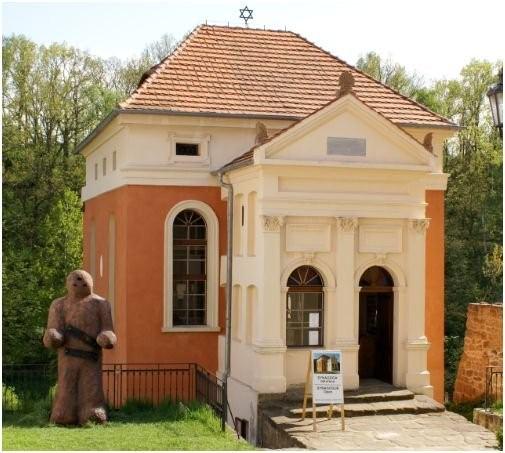
My latest photo and comment (in Italian) are up at the moked.it site -- a Golem guarding the recently restored synagogue in Ustek, CZ.
Photo (c) Ruth Ellen Gruber
Subscribe to:
Posts (Atom)