Showing posts with label synagogue. Show all posts

Sunday, May 1, 2011

Synagogue restored in Beirut

This is a bit out of the 'hood, but Haaretz runs a nice piece about the restoration of the Maghen Abraham Synagogue synagogue in downtown Beirut....

Renovations on the ruined synagogue, which was built in 1925, began in 2009
after an agreement between various religious denominations and permission from the Lebanese government, planning authorities and even Hezbollah. The project received the green light after political officials and community leaders became convinced it could show that Lebanon is an open country, tolerant of many faiths including Judaism. [...]

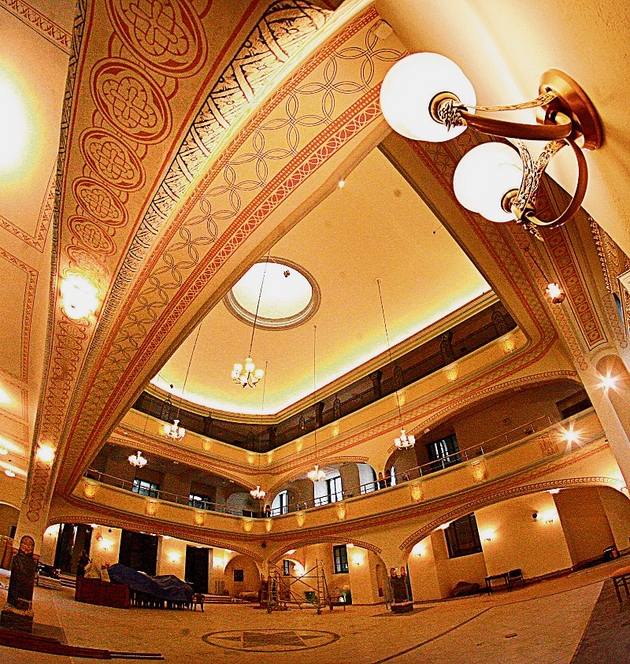
Renovations have included mending the gaping hole in the Moroccan-style synagogue's roof and repairing the chandeliers that once hung from it. The Torah ark and prayer benches will also be refurbished to their former states, having been seriously damaged in fighting between Muslim and Christian forces during the 1975-1990 Lebanese civil war.

Several dozen Jews still living in Lebanon will fund the project to the tune of $200,000, along with others in the Diaspora. The project has also received a $150,000 grant from Solidere, a construction firm tasked with rebuilding central Beirut from the destruction of the civil war. The company is privately owned by the family of Rafik Hariri, the former prime minister assassinated in 2005.
Read full story by clicking RIGHT HERE

Wednesday, April 20, 2011

India -- Jewish Heritage Trail here, too!

The Jerusalem Post runs a lengthy article by Shalva Weil about a nascent Jewish heritage trail in southern India. It is pegged to the situation of the 17th century synagogue in Parur, which is currently being renovated by public authorities after remaining abandoned and somewhat derelict for decades.

Last month, the government of Kerala, India’s southernmost state, armed with a matching grant from the central government, started the reconstruction of the Parur synagogue that used to be frequented by Cochin Jews before they came on aliya, largely in the 1950s. The last of the community immigrated in the 1970s, leaving behind a mere handful of people, and the synagogue has remained in disuse since then. Today, fewer than 40 Cochin Jews remain on the Malabar coast.

The conservation is progressing at such a pace that the chief architect in charge of the project, Benny Kuriakose, believes it will be completed by the autumn. This governmental and federal project could be a beacon for other countries, which pay lip-service to the preservation of Jewish heritage.

“I was very excited to hear that the Kerala government is renovating the Parur synagogue and restoring it to the glory of its past,” said Tirza Lavi, a native of Parur, and a today a curator of the Heritage Center for Cochin Jews at Nevatim, south of Beersheba. “We hope that Parur will be a showcase to the younger generation, displaying our communities’ rich and interesting history. I am sure that Cochin Jews in Israel will be glad to take part in the project and share their knowledge and memories.”

Weil writes that the Jewish heritage trail and Parur synagogue are part of a much larger project.

The reconstruction of the Parur synagogue is only a small cog in the wheel of a huge project called the Muziris Heritage Project, which includes archeological excavations and the reconstruction of other historical monuments in the area, such as temples, churches and mosques. The idea is to create a tourism trail from the ancient port of Muziris, today known as Kodungallor, through Cochin, Parur and other nearby areas, and develop the already-existing tourism boom. Today, Kerala is the eighth most favorite tourist destination in the world.

The seeds of the monumental project were planted only a few years ago. The beautiful Paradesi synagogue in Jew Town, Cochin, constructed in 1568, has been a well-known tourist site ever since Indira Gandhi attended its quatercentenary celebrations in 1968 and the Indiangovernment issued a special commemorative stamp on the occasion. In more recent history, however, the Kerala government agreed to undertake the renovation of another abandoned Cochin Jewish synagogue belonging to the Malabari Jews in the village of Chendamangalam, near Cochin. In February 2006, the synagogue was reopened with an exhibition on the Cochin Jews, and the synagogue has become a popular tourist destination.


Read full article here

Wednesday, April 6, 2011

Greece -- The synagogue in Rhodes

The Jerusalem Post runs a story about the synagogue in Rhodes, the oldest in Greece.

The spacious, Sephardi-style house of worship has a beautiful wooden bima in the middle of the men’s section and an exquisite, traditional white pebble floor with black pebble decorations. Behind the synagogue is a museum, funded by far-flung descendants of the Jewish community, displaying textiles and documents which explain the daily lives and the rituals of the Jews of Rhodes.

Read more HERE

Monday, March 28, 2011

Romania -- Historic synagogue in Iasi under restoration

 Photo (c) Simon Geissbuehler


By Ruth Ellen Gruber

The historic 17th century Great Synagogue in Iasi, in northern Romania, is under restoration. The Swiss historian and diplomat simon Geissbuehler (who has written widely on Jewish heritage in Romania) visited the site last week and provided the picture above. He said the synagogue is empty, and that some work has been completed on the foundations, but that workers on the site did not have a time frame for the work's completion.

The synagogue was built in 1671 and is the oldest surviving synagogue building in Romania. (Before World War II, there were more than 110 synagogus in Iasi alone.) The synagogue has simple lines and tall dome and is set in a small garden, almost totally surrounded by new buildings. Inside, a huge, elaborate Ark, surrounded by frescoes, fills one end of the hall. The former women's gallery for years housed a small exhibit on local Jewish history, organized in the 1980s.

Sunday, March 20, 2011

Wroclaw -- White Stork Synagogue, and More

Photo (c) Ruth Ellen Gruber, 2008

By Ruth Ellen Gruber

After years of stop and start work, the historic White Stork synagogue in Wroclaw, Poland was rededicated this week. The May 6 ceremony was at the heart of four days of cultural events, religious services, commemorations and other activities. These also included an international conference on Jewish religious life in Wroclaw. The full schedule of events can be seen HERE.

The central performer was the Israeli-born, New York-based Cantor Joseph Malovany, cantor of the Fifth Avenue Synagogue. Malovany has used his wonderful voice to encourage and instill hope in Jewish revival in post-communist Europe for many years. He is, in fact, one of the first people I met in this world -- he perfomed in 1989 at the dedication of the newly restored Great Synagogue in Szeged, Hungary, and also at the Dohany St. synagogue in Budapest which, at the time, was still in sadly derelict condition: the roof sagged perilously under plastic sheeting, held up by metal bands. He has sung in Moscow, in Macedonia, in Bucharest, in Warsaw, and in many other places and on many significant occasions: one of the most poignant was in July 2001, when he chanted kaddish at the ceremony in the small eastern Polish town of Jedwabne, during which Poland's then-president Aleksander Kwasniewski, offered apologies for the fact that local Poles had massacred their Jewish neighbors there in 1941. (In 2004, Kwasniewski named him a commander of the Legion of Honor.)


(I can't resist including this video of Cantor Malovany at the Singer's Warsaw Jewish festival in the Nozyk synagogue, in Warsaw, a few years ago)

As I have written previously, restoration and other work on the White Stork synagogue has been spearheaded since 2006 by the Bente Kahan Foundation, established by the Norwegian singer and stage artist Bente Kahan.

The New York Times featured the Synagogue, Kahan and the Jewish Quarter in a recent travel article.

In recent years, Wroclaw’s formerly neglected Old Jewish Quarter, with Wlodkowica street as its anchor, has become one of the city’s hippest neighborhoods, thanks largely to the work of Bente Kahan, a Jewish-Norwegian singer who serves as founding artistic director of the Jewish Cultural and Education center of the White Stork, the city’s only remaining synagogue.

The 19th-century White Stork was once the center of one of the largest Jewish communities in Germany. Since 2005, when Ms. Kahan assumed directorship and started a private foundation to finance community efforts, the White Stork has seen extensive renovations. On May 6 the synagogue will officially reopen to the public at a ceremony unveiling a permanent installation about the history of Jewish life in Wroclaw.

The surrounding neighborhood has also been given new life. Spots like the student-friendly watering hole Mleczarnia, and Sarah, a candlelit restaurant that serves up takes on traditional Jewish dishes, have turned the out-of-the-way Wlodkowica street into one of Wroclaw’s most fashionable avenues.

If you are planning to visit Wroclaw -- don't forget that the annual Simcha Jewish culture festival takes place the last week of May.

Tuesday, March 1, 2011

Poland -- synagogue in Bedzin renovated and reopened


 Before and After pictures from the Cukierman Gate web site


By Ruth Ellen Gruber

Mazel Tov! The Cukierman prayer house, the little private synagogue found hidden in an apartment block in the Silesian town of Bedzin in southern Poland, has been renovated and reopened to the public thanks to a grant from the province. The striking wall paintings that show scenes of Jerusalem, musical instruments and other motifs, were preserved and restored during the six-month restoration project. The prayer house will be open every Saturday afternoon.
Thanks to the last year’s subsidy from the Śląskie Province Conservation Officer it was possible to renovate and partly reconstruct the surviving polychromes. Apart from renovating the paintings, the interior of the prayer house was also slightly rearranged, so that it would be adapted for meetings with young people and all participants of cultural events. [...]  The Cukerman prayer house is one of about forty prayer houses that have survived and are open to visitors in Poland, and it is the only relic in the Śląskie Province, reminding of its past and its Jewish community.
For more information see the Cukierman Gate foundation Web Site -- there are lots of photos documenting the restoration process.

I visited the hidden prayer house last summer and wrote about it on this blog, describing how it is always inspiring to meet  people who take it upon themselves to care for and promote sites of Jewish heritage in Poland (and elsewhere).

Monday, February 28, 2011

Egypt -- Restored Synagogue to be Dedicated


 Video of work on the synagogue

 By Ruth Ellen Gruber

This is a bit off geographic topic, but (as Rabbi Andrew Baker notes in an op-ed today) after an 18-month restoration project by Egypt's Supreme Council of Antiquities, this historic Maimonides (or Rambam, or "Rav Moshe") synagogue and yeshiva in Cairo is to be reopened and rededicated next week.

Sam Gruber has reported that
This is the first major restoration of Jewish site in Egypt since the much-heralded restoration Cairo's Ben Ezra Synagogue in the 1980s and early 1990s, a project put in motion during the euphoria following the Camp David Accords. [...] The Synagogue is actually a 19th century construction that replaces older buildings, but is adjacent to  an historic and venerated yeshiva associated with Maimonides. - which itself has had a recent history of disasters - recurring flooding from underground water and 1992 earthquake damage. The Yeshiva rooms have niches where, until recently, sick Jews, Muslim and Christians would spend the night praying for their recovery, or for women especially, fertility.


Baker, the director of international Jewish affairs for the American Jewish Committee, has an op-ed in the International Herald Tribune/NYTimes web site about the synagogues, the restoration and the politics around the project.  For the past five years Bakes has met regularly on behalf of the American Jewish Committee with Egyptian officials to press for the preservation of Jewish heritage, which, in addition to Rav Moshe, includes a dozen synagogues and several cemeteries in Cairo and Alexandria, most of them in poor repair.

The nearly $2 million restoration involved a team of Egyptian experts. Few people were aware of it until last September when Dr. Zahi Hawass, Egypt’s antiquities czar, brought reporters to the site and declared: “It’s part of our history. It’s part of our heritage,” Dr. Hawas proudly declared. Some cynics suggested that the project was initiated to shore up the candidacy of Egypt’s culture minister, Farouk Hosny, in his unsuccessful bid to head Unesco.

But, write Baker: this was not just any synagogue. Rav Moshe was considered to have special healing powers. One elderly Egyptian Jew now living in Europe told me how his childhood stuttering disappeared after his mother made him spend the night there. His miracle cure was a commonplace experience for many of Cairo’s Jews who sometimes called it the “Jewish Lourdes.”  [...]
In Maimonides’ day, Cairo’s Jewish community was a center of scholarship and commerce, a hub of Jewish life for the entire Middle East. When[ King] Fuad ruled Egypt, more than 80,000 Jews were among his subjects. They were an active, integral presence in the business and cultural life of the country. But that all changed after Israel’s creation in 1948, and especially after Gamal Abdel Nasser seized power in 1953, prompting a mass exodus of Jews. Today’s Jewish population in Egypt is a mere few dozen. [...]
Both Farouk Hosny and Zahi Hawass came to accept the argument that the preservation of Egypt’s rich Jewish heritage was also their obligation. Slowly but quietly — always quietly — they drew up plans for restoring most Jewish religious sites. They even endorsed our proposal that one of the restored synagogues should serve as a Museum of Egyptian Jewish Heritage, a place that would tell of the long, rich history of Jewish life in Egypt. Only a few knew. Every meeting I had with these Egyptian officials ended with the same admonition — “Please, do not tell anyone.”
Why the secrecy when most governments would want the world to know of such commendable preservation work? In Egypt, the history of living alongside Jewish neighbors has been replaced with the demonizing of Israel, and often of Jews as well. The historic 1979 Egyptian-Israeli peace treaty has for too long been ignored by Egypt’s cultural elites who have steadfastly rejected any normalization in relations. Minister Hosny and his colleagues have had reason to fear that Egyptians would react with anger when told of the restoration work.
But the word is out now. And Zahi Hawass, an archeological legend known around the world for touting pyramids and the treasures of King Tut, is now reading up on the deeds of a medieval rabbi. Dr. Hawass promises that six more synagogue buildings in Cairo will be restored within two years. Egypt’s Jewish artifacts will never rival those of the Pharaohs. But reminding today’s Egyptians and others in this troubled region of a time when Jews were a natural part of Egyptian society is important. It may even be a ray of hope when hope is so hard to find in this region. Maybe there will emerge one more miracle to credit to Rav Moshe.
Read full article at the web site

Wednesday, February 16, 2011

Greece -- Arrests in Hania Crete Synaogogue Arson attacks

By Ruth Ellen Gruber

The BBC reports that arrests have been made in the two arson attacks this month that serious damaged the historic Etz Hayyim synagogue in Hania, Crete. In custody are a Greek man and two British men -- waiters in local restaurants -- and two Americans are sought.
The BBC's Malcolm Brabant in Athens said [that], according to the police, the men are aged 23 and 33 and are nightclub waiters in the seaside town. Police said they were arrested after a 24-year-old Greek man confessed, our correspondent added. The British men have been offered assistance by consul staff on the island.
Read full story HERE

Meanwhile, the synagogue blog continues to carry updates, including some reflective pieces by Tony Lerman.

Monday, February 14, 2011

Poland -- Wroclaw synagogue: restoration of interior complete

Zdjęcie: Wnętrze synagogi Pod Białym Bocianem już zachwyca. Cała będzie gotowa na wiosnę (Paweł Relikowski)

 Photo from Gazeta Wroclawska newspaper. Click HERE

Gazeta Wroclawska newspaper reports that the restoration of the interior of the historic White Stork Synagogue in Wroclaw has been completed. The article is in Polish (it translates with Google translate) but also runs pictures you can see by clicking HERE.

The synagogue is to be rededicated in May. The article states that interior furnishings will be installed in April.

I posted previous information on the restoration in December -- click HERE.

Sunday, February 13, 2011

Second attack on Hania synagogue!


Pictures courtesy of the Etz Hayyim blog.

Nikos Stavroulakis writes that there has been a second arson attack at the historic Etz Hayyim  synagogue in Hania, Crete -- just ten days after vandals broke in and set the interior alight on Jan. 5. The second attack  took place just hours after Friday night services and destroyed the archives of the synagogue, gutted the offices and damaged the sanctuary.  See more pictures at the synagogue web site/blog HERE.
On the night of Friday, January 15, after more than a week of work on the sanctuary – newly scraped, primed and re-painted; the wood-work oiled with lavender and the marble floor polished – we met for Erev Shabbat prayers and Kiddush. Later we locked the synagogue and returned to our homes feeling that we had set our steps forward. Saturday morning at 3:30 AM however the Synagogue’s director was wakened by the alarm that had been set off in the Synagogue and rushed there accompanied by two helpers to find the entire main office ablaze. They began putting out the fire with the garden hose as the firemen had not yet succeeded in getting their hoses connected. When the mains were finally connected the firemen set to work – by 4:45 the fire was only smoldering and all that remained of the upper and lower office was completely gutted. Also about a third of the wooden ceiling of the Synagogue itself was burnt, the benches covered in soot and broken wood, the floor a mess – but the EHAL was not touched! Everything in the main office – e.g. two computers, complete Talmud, Midraschim, 2 sets of Rashi lexicons (Aramaic, Greek and Hebrew) plus many reference books and the entire archive of the Synagogue have all been destroyed.
By noon the Siphrei Torah along with all of the silver ornaments (rimonim, tassim, yads etc.) and a precious early 17th century illuminated Qur’an were removed to a secure location. It was a sad moment to see them being taken away from the Kal as it was a joyous moment when they had been installed in 1999. But we are determined that they will come back!


My latest Ruthless Cosmopolitan column -- on the arson attack at the Hania synagogue

In my latest Ruthless Cosmopolitan column, I discuss the implications of last week's arson attack on the synagogue in Hania, Crete.

RUTHLESS COSMOPOLITAN
Attack on Crete synagogue carries special meaning

By Ruth Ellen Gruber · January 13, 2010

ROME (JTA) -- The vandals who torched the historic Etz Hayyim synagogue in Hania, an ancient port on the Greek island of Crete, left no doubt about their motives.

After breaking into the building on the night of Jan. 5 and setting its interior alight, they threw a bar of soap against its outer wall.

A bar of soap? That's because, explains the synagogue's director, Nikos Stavroulakis, "I'll make you into a bar of soap" is a common anti-Semitic taunt in Greece. Since the Holocaust, there has been a persistent belief that the Nazis made soap from Jewish corpses.

Even though scholars have disproved the idea, bars of soap have been buried reverently in some European Jewish cemeteries under solemn memorials.

"In this place lie the remains of Jewish martyrs exterminated by German fascists and turned into soap," reads the inscription on an obelisk in Piatra Neamt, Romania.

The power of this belief was examined in "The Soap Myth," a play by Jeff Cohen that ran last summer in New York. Based on a true story, the play focused on the efforts of an elderly Holocaust survivor "on a one-man mission to get the 'soap myth' reclassified as fact," Marissa Brostoff wrote in Tablet magazine.

But at the heart of the story was something much more.

What was at stake, Brostoff wrote, was "the way we choose to see the past, a struggle between a dispassionate approach relying on facts and figures and another, much more subjective one that holds survivors' testimonies to be unarguably true and ultimately sacred."

Anti-Semitic violence is anything but dispassionate.

The bar of soap hurled against the desecrated synagogue in Hania was a diabolically mixed metaphor: Soap usually symbolizes purity and godliness, but in this twisted context it spelled hatred and death.

The attack on the Hania synagogue was not just an assault on a building. It was an assault on the ideals that had transformed the structure from a wrecked relic of Holocaust destruction to a new symbol of community and compassion.

This transformation was accomplished largely through the efforts of Stavroulakis, a remarkable man who has devoted much of the past two decades to restoring a Jewish presence to a city made "Judenrein" by the Nazis.

I met Stavroulakis when I visited Hania in 1996. An artist, author and scholar who had co-founded and directed the Jewish Museum in Athens, Stavroulakis had returned to live in his family's rambling house in Hania after many years away.

The synagogue, which dates back to the 15th century, was in ruin. But over the next three years Stavroulakis made it his mission to raise funds and, with the help of the World Monuments Fund and other donors, oversee the building's rebirth. His aim was to make it a living spiritual presence, not simply a restored reminder of the past.

The synagogue now functions as a museum, and it hosts exhibitions and cultural events.

It’s also an active house of worship. A small Havurah community whose members include Christians and some Muslims -- as well as Jews of all persuasions -- regularly assembles there to celebrate Shabbat and Jewish holidays.

Stavroulakis himself leads daily prayers each morning, whether a minyan is present or not.

Prayers were held as usual at 9 a.m. Jan. 6, the morning after the arson attack. The fire had gutted a stairway, wreaked havoc on the synagogue library, and covered walls and precious furnishings with a thick layer of soot.

"Fortunately," Stavroulakis said, "the fabric of the synagogue was and is intact."

He was referring to the physical structure of the building, but I think he also meant that the symbolic identity of the synagogue also had survived -- and would be maintained.

"We must be angry over what has happened to our synagogue," he told the small group of worshipers gathered for prayers amid the soot. "If we were not, it would be an indication that we were either indifferent or morally numb."

But, Stavroulakis asked, just where should the anger be directed? Local indifference and the ignorance that promotes racism had to be addressed.

"We have tried at Etz Hayyim to be a small presence in the midst of what is at times almost aggressive ignorance," he wrote on the synagogue blog. "We have done this to such a degree that our doors are open from early in the morning until late in the day so that the synagogue assumes its role as a place of prayer, recollection and reconciliation."

There is, Stavroulakis wrote, little if any sign of overt security.

"This character of the synagogue must not change and the doors must remain open," he wrote. If not, that means "we have given in to the ignorance that has perpetrated this desecration."

A week after the attack, the Etz Hayyim blog posted pictures showing that thanks in large part to volunteers, the walls of the sanctuary already had been painted and other clean-up work was well under way.

"The impact of this [attack] will be wider than simply an act of terrorism against Jews," Stavroulakis told me. "Already it is being seen in a much wider social context that has to do with civic responsibility and care."
 Read story at JTA web site

Tuesday, February 8, 2011

Greece -- Full Report on the Destructive Arson Fire at the Etz Hayyim Synagogue in Hania

 [DSC09972.JPG]
 Destroyed library of synagogue. All Photos courtesty Etz Hayyim web site

Sam Gruber posts pictures and a full description of the destructive arson attack Tuesday night on the beautiful Etz Hayyim synagogue in Hania, Crete.

The fire severely damaged the recently restored ezrat nashim (former women's section) of the historic synagogue, and entirely destroyed the library and computer stations. Additional damage from soot and water to the rest of the structure and furnishing can be repaired, but at a considerable cost.


Sam posts the description presented on the synagogue's web site by our old friend Nikos Stavrolakis, the director of the synagogue complex, who personally raised money for and oversaw the restoration of the building in the late 1990s.  I vividly remember visiting the synagogue with Nikos in 1996, when it was still pretty much a ruin, and listening to his hopes and plans for it.

http://blog.etz-hayyim-hania.org/wp-content/uploads/2010/01/DSC09951.JPG

In his description, Nikos reflected about the significance of the synagogue and the attempt to destroy it --noting that the perpetrators had thrown and bar of soap against the burning building -- a reference to a "common anti-semitic quip in Greek [that] runs…’I'll make you into a bar of soap!’" and that local people apparently did not react.

What was quite notable was the lack of ‘locals’ despite the quite incredible noise of the synagogue alarm system and sirens from the two fire engines screeching through the neighborhood. What was even more disturbing and an obvious sign of a lack of civic responsibility was the apparent lack of sensitivity to the fact that had the synagogue been engulfed in flames at least half of the old city of Hania would have gone up in flames as the narrow streets and inaccessible quarters would have prevented access by the fire brigades.

We must be angry over what has happened to our synagogue. If we were not it would be an indication that we were either indifferent or morally numb. But exactly against what is our anger directed? The urban context in which Etz Hayyim figures at this moment must be considered carefully and any indifference on the part of the citizens to the material fabric of this city and its collective ‘psyche’ is tantamount to abetting to a degree the desecration of monuments, of homes and sites of common meeting.
What we must be angry about is the ignorance that determines racism, discrimination or badly examined lives. We have tried at Etz Hayyim to be a small presence in the midst of what is at times almost aggressive ignorance. We have done this to such a degree that our doors are open from early in the morning until late in the day so that the Synagogue assumes its role as a place of prayer, recollection and reconciliation. In many ways we have been successful through this quiet presence – perhaps our ‘silent presence’ wears not too well on some and is even a source of annoyance to others.
Often I have pointed out that we are perhaps the only synagogue of significance in Greece, possibly Europe, where there is little if any overt sign of protective security. Hand-bags are not checked, ID cards and passports are not examined, and one is not obliged to sign in. This character of the Synagogue must not change and the doors must remain open – or we have given in to the ignorance that has perpetrated this desecration. Our awareness of what ignorance can do to us will certainly determine how certain repairs are to be made – but at the same time we must be cautious about allowing ignorance to affect or determine the nature of our presence. We will have a heavy burden of funding the necessary renovations and we hope that you as either old friends or new ones will assist us. Any donations will be deeply appreciated and, of course, welcome.

The web site has a slide show of images showing the extent of the damage, which included the destruction of the valuable library and music collection.

http://blog.etz-hayyim-hania.org/wp-content/uploads/2010/01/DSC09970.JPG
At approximately 12:20-1:00 AM on the night of the 5th January [,,,] one or two or even more individuals made their way into the south garden of the synagogue by climbing over the iron gate. Subsequent to this they set about making an improvised incendiary device by tearing open a large Ottoman cushion in the mikveh and then with the contents stuffed a canister that was filled with some flammable liquid which was then set afire under the wooden stair of the ezrat nashim. 
(The upper floor of the women’s section (ezrat nashim) serves as the office of the director as well as a library and reading room and contains valuable books in various languages on Ottoman, Byzantine and Jewish art and architecture as well as resource books on European and Near Eastern History from pre-historic times as well as a large section on Cretan history. A computer and CD player with over 150 CDs of Sephardic liturgical and secular music were also kept in the office.) Within probably minutes the assailants had taken off and the fire produced smoke that poured into the synagogue proper and then out into the street through the oculus in the facade of the synagogue.
Yannis Pietra, an Albanian emigrant living not far from the Synagogue, smelled the smoke and looking into the street saw it belching out of the facade and called the police, fire-station and then set off to find the director who arrived not long after along with Besnik Seitas the handyman of the Synagogue. At roughly the same time a young Moroccan, Nasr Alassoud, also traced the smoke that was coming down the street to the harbor. He proved to be a much needed hand by the director. By 1:45 AM the fire brigade had extinguished the fire and the police had begun their work. But the residual damage was only going to be apparent the next day.

Make donatation to efforts to repair the synagogue and rebuild the library to:

ALPHA BANK (Hania, Crete)
Account name: Friends of Etz Hayyim
Account # 776-002101-087154
IBAN:  GR74 0140 6600 7760 0210 1087 154
Nicholas Hannan-Stavroulakis / Director Etz Hayyim Synagogue/ Hania

Friday, February 4, 2011

Italy -- Historic Synagogue in Sabbioneta Closed


By Ruth Ellen Gruber

The entry stairway to the early 19th century  synagogue in the historic northern Italian town of Sabbioneta has been declared unsafe and the building, now used as a museum, closed to visitors.

Sabbioneta, on the Po River near Mantova, was laid out as a walled "ideal city" in the second half of the 16th century by Prince Vespasiano Gonzaga Colonna. It is on UNESCO's list of world heritage sites, paired with Mantova as two aspects of Renaissance town planning.
Mantua shows the renewal and extension of an existing city, while 30 km away, Sabbioneta represents the implementation of the period’s theories about planning the ideal city. Typically, Mantua’s layout is irregular with regular parts showing different stages of its growth since the Roman period and includes many medieval edifices among them an 11th century rotunda and a Baroque theatre. Sabbioneta, created in the second half of the 16th century under the rule of one person, Vespasiano Gonzaga Colonna, can be described as a single-period city and has a right angle grid layout. Both cities offer exceptional testimonies to the urban, architectural and artistic realizations of the Renaissance, linked through the visions and actions of the ruling Gonzaga family.


Sabbioneta represents the construction of an entirely new town according to the modern, functional vision of the Renaissance. The defensive walls, grid pattern of streets, role of public spaces and monuments all make Sabbioneta one of the best examples of ideal cities built in Europe, with an influence over urbanism and architecture in and outside the continent. The properties represent two significant stages of territorial planning and urban interventions undertaken by the Gonzagas in their domains.
Jews lived in Sabbioneta from the town's early days -- even before it was laid out in its present form. There was a ghetto here, and the town developed into an important center of Hebrew printing.   The Sabbioneta synagogue dates from 1824 -- its present form is an enlargement and rebuilding of an earlier structure by a noted Lombard architect named Carlo Visioli.

The synagogue lay in sorry disrepair for decades until it was restored by local authorities, turned into a museum and inserted into local tourism itineraries. It has a gilded ark behind a low, elaborate grille and  flanked by Corinthian columns. The ceiling is decorated by ornate stucco work.

Friday, January 28, 2011

Romania --Piatra Neamt Wooden Synagogue to be Rededicated


Interior of Piatra Neamt wooden synagogue, 2006. Photo (c) Ruth Ellen Gruber


Interior of Piatra Neamt wooden synagogue, 2006. Photo (c) Ruth Ellen Gruber


Ark in Piatra Neamt wooden synagogue, 2006. Photo (c) Ruth Ellen Gruber


By Ruth Ellen Gruber

The "Baal Shem Tov" or Cathedral wooden synagogue in Piatra Neamt, Romania, will be rededicated Dec. 14 after restoration.


Legend has it that the Ba'al Shem Tov, the founder of Hassidism, prayed here -- that is, on an earlier, masonry synagogue that  stood on the spot, as the wooden synagogue was built, according to documentation, in 1766, and the Ba'al Shem Tov died in 1760.

I've visited on several occasions, the last time in 2006.  This is what I wrote in Jewish Heritage Travel:
The present building is halfway underground, probably built like this to conform to regulations that forbade synagogues from being higher than surrounding Christian buildings. The sanctuary is entered down stairs leading from a little outer prayer room, where regular services are held. Chandeliers hang from the ribbed wooden dome arching over the dull, browny-green walls decorated by pale stenciled flowers. Carved and gilded lions, griffins, bunches of grapes and other decorations ornament the compact but elaborate Aron ha Kodesh, built in 1835 by one Saraga Yitzhak ben Moshe.
Sam Gruber has posted further information and comment on his blog.

The wooden synagogue stands next door to the masonry Great (or Leipziger) synagogue, which was originally built in 1839. It is very similar to other folk-style Moldavian synagogues, with  a small, raised bimah with a trellised frame situated in the middle of the sanctuary in front of a highly elaborate Aron ha Kodesh with tromp l'oeil draperies. The walls are decorated with bright frescoes representing Holy Land themes, and frescoes of biblical animals -- the stag, the lion, the tiger and the eagle -- are painted on the ceiling.


Ark in Great synagogue in Piatra Neamt, 2006. Photo (c) Ruth Ellen Gruber

Monday, January 24, 2011

Poland -- Restoration of the Wroclaw Synagogue Almost Complete


 White Stork Synagogue, restored facade (Photo: Bente Kahan Foundation)


 White Stork Synagogue before restoration. (Photo: Bente Kahan Foundation)

By Ruth Ellen Gruber

The Wroclaw, Poland-based Norwegian singer Bente Kahan reports that the restoration of the historic White Stork Synagogue in Wroclaw is nearly complete, and that the synagogue will be rededicated next May 6.

As I reported on this blog from Wroclaw last year, Kahan set up a foundation in 2006 (The Bente Kahan Foundation) whose main aim is the restoration of the synagogue and creation of a modern Jewish Culture Center and Jewish Museum there. The Center has already been operating in the partially-restored synagogue, organizing, the web site states: "exhibits, film screenings, workshops, lectures, concerts and theatre performances. Included in their programs are also their own productions 'Wallstrasse 13' and 'Voices from Theresienstadt' featuring local actors and musicians, as well as 'Sing with us in Yiddish', a concert with children from Wroclaw."
The Bente Kahan Foundation, supported by the Municipality of Wroclaw and the Association of the Jewish Religious Communities in Poland has a clear vision of future functions of the synagogue. The Center for Jewish Culture and Education will strengthen the role of the temple as one of the most attractive spiritual centres in the country by opening its doors for concerts, shows, theatre, workshops, films, lectures seminaries and so on. This living Jewish heart in the centre of Europe will beat even stronger!
The creation of the modern Jewish Museum in Wroclaw (2012) will definitely help to reach that goal. The Museum will be located in the basement and on the balconies of the synagogue floors. The Staircases and the separate entry will enable free communication with the building without disturbing the sacral and cultural space of the temple. By using of modern 3D and holographic techniques, the museum will show the rich and unique world of the Silesian Jews and their thousand-years-old history. It will also be a place for exhibitions, lectures and workshops. The museum will become no just another tourist attraction but also an important link in the educational proces, especially in the context of young people.
Kahan has set up web site dedicated to the synagogue and its restoration (only in Polish).


Interior before renovation. (Photo: Bente Kahan Foundation)


Interior after renovation (Photo: Bente Kahan Foundation)

Before World War II, Wroclaw, known in German as Breslau, was part of Germany and Germany's third-largest Jewish community. Originally inaugurated in 1829,  the White Stork synagogue is an elegant neo-classical structure designed by Karl Ferdinand Langhans. (For a complete history of the building, click HERE.) It is the only synagogue in the city to have survived the War and languished in disrepair for many years. It was returned to Jewish community ownership in the mid-1990s, after which sporadic restoration work was carried out. (A symbolic event in this process was the wedding there in 2000 of the American filmmakers Ellen Friedland and Curt Fissel, who run the documentary company JEM/GLO.)

There is still a small Jewish community in Wroclaw, which uses a refurbished prayer room in the synagogue complex. A big Jewish Culture Festival called Simcha takes place in Wroclaw each summer.


Photo (c) Ruth Ellen Gruber


Wroclaw also has two fascinating Jewish cemeteries.

The Old Jewish Cemetery, founded in 1856, is now maintained as a municipal Museum of Cemetery Art.  Located on Slezna street, it has about 12,000 graves, including 300 elaborate monuments ranged around the walls. The earliest known Jewish gravestone in Poland, that of a David ben Shalom, who died in 1203, is conserved here. Notable people are buried here include the German Social Democratic leader Ferdinand LaSalle (1825-1864) and the parents of Edith Stein, a Jewish intellectual and convert to Catholicism who became a nun, was killed at Auschwitz and was canonized by Pope John Paul II.


Detail of a Tombstone in the Old Jewish Cemetery: a snake circling an hour glass. Photo (c) ruth Ellen Gruber

Poland -- New Pictures of Lancut Synagogue

The Foundation for the Preservation of Jewish Heritage in Poland (FODZ) has posted a gallery of gorgeous new pictures of the synagogue in Lancut, Poland, part of the Hassidic route that it sponsors.

Click HERE for the gallery.

Monday, January 3, 2011

Poland -- Good News (Maybe) about Przysucha synagogue


 Synagogue in Przysucha, 2006. Photo (c) Ruth Ellen Gruber

By Ruth Ellen Gruber

The Foundation for the Preservation of Jewish Heritage in Poland (FODZ) reports that progress seems to be being made regarding the restoration and preservation of the imposing, 18th century synagogue building the Przysucha. The FODZ web site reports that a meeting will be held tomorrow about the synagogue's fate.
On October 26th, 2009 in Przysucha representatives of the Foundation for the Preservation of Jewish Heritage in Poland will meet with representatives of the local NGO’s: Oskar Kolberg Cultural Society and Music Education Society as well as the Oskar Kolberg Museum in Przysucha. The meeting will be dedicated to the concept of the historical synagogue’s development.
Przysucha was a major center of Hasidism in Poland -- Martin Buber mentione d seven Tzaddikim from the town. It was the seat of the influential Hasidic masters Abraham of Przysucha (d. 1806) and Jacob Yitzhak ben Asher (1766-1813), known in lore simply as the Holy Jew of Przysucha, who is credited with being the first propagator of Hasidism in Central Poland.  Jacob Yitzhak's disciple Simcha Bunem (1784-1827) also lived here. Their tombs in the Jewish cemetery, which is near the synagogue, are places of pilgrimage.

Przysucha was founded in 1910 as a settlement of German ironworkers. Jews lived here from the beginning, and by 1921 made up two-thirds of the population of 3,200.

The synagogue is one of the largest of Poland's surviving synagogues. It was heavily damaged in World War II when the Germans used it as a warehouse.  It conserves traces of structural and decorative detail, including the central bimah, the women's gallery, a few faded frescoes and much of the Aron ha Kodesh, with stucco work above it. Attached to the outside wall is a rare example of a kune, or pillory, where Jews sentenced by the Jewish community court would be locked in punishment.


The Kune. Photo (c) Ruth Ellen Gruber.

FODZ, which took possession of the badly deteriorated building two years ago, has a web page dedicated to the synagogue and efforts to revitalize it. On the page you can see architectural drawings and other material.


In 2008, we carried out essential protective renovations, but the building still needs urgent repairs. The roof is in a very bad condition and the interior is rapidly deteriorating due to excess moisture. Currently we are working on the construction and conservation documentation. Once it is completed, we will be able to apply for funding necessary to start the restoration and adaptation works.

The synagogue in Przysucha (yid. Parshishe vel Przishe) was built between 1774 and 1777. With an area of nearly 600m², it is a massive limestone building towering over a small town (current population: 6800). The main prayer chamber is rectangular, with a vaulted ceiling descending in the middle towards a four-piered structure formerly framing the bima (reader’s podium). The aron ha-kodesh, framed by a portal topped with stucco griffins, has also been preserved. Some polychromies remain on the walls.


  Photo (c) Ruth Ellen Gruber, 2006

Thursday, December 16, 2010

Bulgaria -- pictures of the restored Sofia Synagogue

Sofia, Sept. 9 , 2009. Photo courtesy Robert Djerassi


By Ruth Ellen Gruber

My last post included news about the restoration of the Great Synagogue in Sofia, with ceremonies marking the synagogue's 100th anniversary.

Robert Djerassi, whom I quoted and who was one of the organizers of the celebrations, has sent a couple of pictures of the event -- he and everyone else in Sofia I've talked to say they can't believe how beautiful it is.

Sofia, Sept. 9, 2009. Photo courtesy of Robert Djerassi

Wednesday, December 15, 2010

Budapest/Sofia -- a Tale of Two synagogues

Dohany St. Synagogue, 150 years (young). Photo (c) Ruth Ellen Gruber


My latest Ruthless Cosmopolitan column is about the big birthdays of the great synagogues in Budapest and Sofia. JTA ran a brief story with details of the Dohany St. synagogue anniversary events on Sept. 6, which were attended by VIPs and included the opening of an exhibition.

Dohany synagogue ceremony: bringing in the Torahs. Photo (c) Rudolf Klein

The ceremony marked the start of a yearlong program of cultural events celebrating the synagogue, including a major exhibition of the history of building. The National Bank of Hungary has issued a commemorative coin. [...]

“The synagogue has never ceased to serve the Jewish community despite the events of two world wars,” Hungarian Chief Rabbi Robert Frolich declared at the ceremony.

Prime Minister Gordon Bajnai said the consistent contribution of the Jews has hugely enriched and strengthened Hungarian society. He expressed regret over the need to station policemen permanently before the building to protect it from attack.

Hungary must "quarantine" the political ideas of neo-Nazism and "socially isolate" its advocates who would like to bring back the horrors of the Holocaust today, Bajnai said.
Rudi Klein -- the author of a new book about the synagogue -- was there and sent some nice photos.

Before the Dohany synagogue ceremony. Photo (c) Rudolf Klein


RUTHLESS COSMOPOLITAN

By Ruth Ellen Gruber

Sept. 7, 2009

BUDAPEST, Hungary (JTA) -- This year marks a number of momentous anniversaries: the 70th anniversary of the outbreak of World War II; the 40th anniversary of Woodstock; the 20th anniversary of the fall of communism.

We use anniversaries like these to stop, step back and evaluate not just the event that's being commemorated, but also the passage of time since it happened and the changes wrought with that passage.

In this context, two significant Jewish anniversaries are taking place in September.

The Dohany Street Synagogue in Budapest -- the largest synagogue in Europe -- turns 150 years old. And the Great Synagogue in the Bulgarian capital of Sofia turns 100.

OK, they are buildings, not earth-shaking events. But given the impact that some of the other "big" anniversaries had on these synagogues and on what they represent, it's only fitting to highlight their birthdays on the roster of celebrations.

For one, both are magnificent buildings that stand out architecturally as important city landmarks. Partly because of this, both have undergone recent renovations that restored them to opulent glory after decades of postwar neglect.

Both also are flagships of faith, or at least of Jewish identity, and are survivors, too. Witnesses to the pendulum swing of tragedy and triumph that has marked Jewish history in the region, they are potent physical symbols of a proud and enduring Jewish presence.

"The Dohany Synagogue is still the main synagogue of all the Jews of Hungary, the main identity place where we gather, whether we are religious or not," said architectural historian Rudolf Klein, author of the 2008 book about the synagogue, “The Great Synagogue of Budapest.”

As many as 90,000 Jews are believed to live in Budapest, but most are unaffiliated or totally secular.

With its red-and-yellow striped facade, sumptuous decor and two tall spires topped by gilded onion domes, the Dohany is, in fact, one of the most distinctive buildings in the city and was recognized as such from the outset.

Designed by the Viennese architect Ludwig von Forster, it was inaugurated on Sept. 6, 1859. Old engravings show dignitaries in shiny top hats gathered in front of its enormous ark, a domed and gilded structure that itself is the size of a small chapel.

At the time, Jews had not yet achieved full civil rights in Austro-Hungary. Yet the synagogue was the largest house of worship in Budapest and probably the biggest synagogue in the world. One local newspaper called it "a gorgeous piece of architecture."

"I like it as a Jew and as an architect," Klein told JTA. "In both areas it was a breakthrough."

The synagogue's Moorish style launched a genre and set the pattern for hundreds of synagogues built in later years throughout Central Europe and beyond.

The building's monumental scale, its prominent location and its opulent ornamentation, Klein said, epitomized "the optimism of 19th-century Jewry and the tolerant attitude of the gentile world which prevailed in the capital" at the time.

Things, of course, changed later. During World War II the synagogue was used as a concentration camp, where Jews were massed before their deportation to Auschwitz. The graves of Holocaust victims fill the courtyard.

After the war, under communism, the building languished for decades in a sorry state of disrepair. I vividly remember how its ceiling, held up by cables and plastic sheeting, sagged perilously over the congregation that would pack the sanctuary on Yom Kippur simply to make a statement of identity in the face of the regime’s religious suppression.

In 1996, it was officially reopened following a five-year restoration that was financed largely by the newly democratic Hungarian state.

"This building symbolizes the survival and the continuity of the Jewish people," Gusztav Zoltai, chairman of the Association of Hungarian Jewish Communities, declared at the time.

The Sofia synagogue was inaugurated in September 1909, nearly 50 years to the day after the Dohany, and fulfilled a similar role.

Czar Ferdinand himself cut a ribbon to formally inaugurate the building, whose huge dome, slim turrets and lavish, Byzantine-Moorish style fit in with many other grand buildings in downtown Sofia. The prime minister, other government VIPs and local bishops were in the crowd, too, and a procession of rabbis bore Torah scrolls into the sanctuary and placed them in the ark.

"This synagogue will connect us with the past generations and will tell of us to the future ones," the chief rabbi proudly told the congregation 100 years ago. "May God bless this land which we love dearly, for the good of all Bulgarians, in whose sufferings and joys we take an active part."

Bulgaria's 50,000 Jews were saved during World War II by the heroic action of some of the country's leaders, and most of them moved to Israel.

The Great Synagogue, damaged in 1944 by Allied bombing, stood neglected for decades, as Communist authorities unsuccessfully tried to turn it into a concert hall.

Still, recalled Robert Djerassi, one of the chairmen of the synagogue centenary celebrations, "It was an enormous domed building that awed me with its magnificence each time I stepped inside. Such a huge void: fearsome, lofty, dark and mysterious!"

Only a few thousand Jews live in Bulgaria today, but as in Budapest, restoration of the synagogue was a priority after the fall of communism as a public demonstration of both Jewish renewal and Jewish presence in the city.

The first stage of work was completed in 1996, the final one this year, just in time for September's five-day birthday bash.

Bulgarian President Georgi Parvanov served as honorary chairman of the gala events, echoing the high-profile participation in the synagogue's original dedication a century ago. I'm not sure if I found this moving or ironic, but I'm rather glad he chose to do so.


Read Full Story at JTA

Friday, December 10, 2010

Romania -- Family history

Great Synagogue, Radauti. Photo (c) Ruth Ellen Gruber


By Ruth Ellen Gruber

I'm too tired to write much tonight. Suffice it to say that the Cousins and Candlesticks tour had its genealogical high spots.... We visited the tomb of our great-grandmother, Ettel Gruber, in the Jewish Cemetery in Radauti (where I have been three times before since 1978).

Photo: Doru Losneanu

Thanks to the good efforts (and contacts) of Doru Losneanu, Mr. Dorian Frankel helped us go through records at the Radauti Town Hall. We found the marriage registry for the parents of both our Grandfather, Ephraim/Frank (that is, Anschel Gruber, widower, aged 34 and Ettel Lecker, single, aged 19) in 1880 and our grandmother, Rebecca Rosenberg (David Rosenberg and Celia Halpern) in 1902.


This also gave us the address in the village of Vicovu de Sus where, it seems, Anschel Gruber lived at the time of his marriage.

We drove to Vicovu de Sus, about 1/2 an hour's drive, up at the border with Ukraine -- there is a border crossing there for local people. It's a village strung out for seeming miles along one road... with the help of a couple of very nice local policemen, we found what we believe was the house, an old wooden farmstead, set down a dirt track, amid cornfields, well of the road (apparently an elderly woman, as well as a barking dog, lives there -- and she does have a satellite dish...).